


On-Page vs Off-Page SEO: What Every Business Owner Should Know
Most business owners have heard the word SEO thrown around in meetings, proposals, and agency pitches. But when someone actually asks what the difference is between on-page and off-page SEO, the room goes quiet.
It’s not a complicated concept — it’s just rarely explained well. And understanding it matters, because if you’re investing in SEO without knowing which part you’re paying for, you can’t tell whether it’s working.
Here’s a clear, practical breakdown.
What Is On-Page SEO?
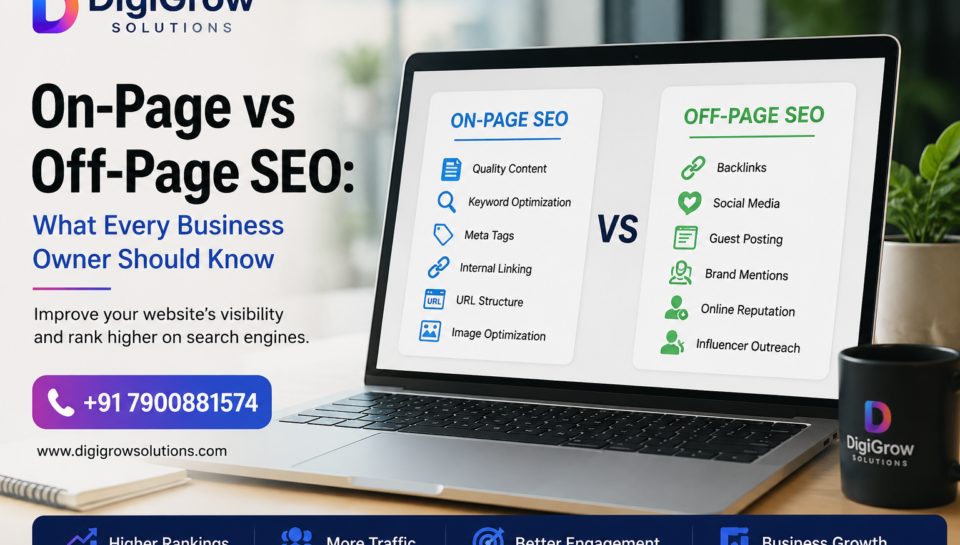
On-page SEO refers to everything you do on your own website to help it rank better on Google. It’s fully within your control — the words on the page, how the page is structured, how fast it loads, and how clearly it communicates to both users and search engines what it’s about.
Think of on-page SEO as setting up your shop correctly. The signboard is readable, the products are organised, the lighting is good, and everything is where a customer would expect to find it.
Key On-Page SEO Elements
Title Tags and Meta Descriptions
Every page on your website has a title tag — the blue clickable headline you see on Google search results. This should include your focus keyword naturally and give users a clear reason to click. The meta description is the short text below it. Neither should be stuffed with keywords, but both should be written intentionally.
Heading Structure
Your content should follow a logical hierarchy — one H1 (the main topic), followed by H2s for major sections, and H3s for sub-points within those sections. Google uses this structure to understand what your page is about and how the content is organised.
Keyword Placement
Your focus keyword should appear naturally in the first 100 words, in at least one subheading, and throughout the content where it reads normally. Forced repetition hurts more than it helps.
Image Optimisation
Every image should have a descriptive alt text — a short phrase that tells Google what the image shows. This helps with both accessibility and image search ranking.
Internal Linking
Linking from one page on your site to another relevant page helps Google crawl your site more effectively and distributes ranking authority across your content.
Page Speed and Mobile Friendliness
These sit at the intersection of on-page and technical SEO. A page that loads slowly or breaks on mobile will not rank well regardless of how good the content is.
What Is Off-Page SEO?
Off-page SEO covers everything that happens outside your website that influences your ranking. Google doesn’t just look at your website in isolation — it looks at what the rest of the internet thinks about you.
The primary signal here is backlinks — other websites linking to yours. When a credible website links to your content, Google treats it as a vote of confidence. The more quality votes you have, the more authority your site builds in your niche.
Off-page SEO also includes your social media presence, brand mentions across the web, your Google Business Profile activity, and how widely your business information is cited across directories.
Key Off-Page SEO Activities
| Activity | What It Does |
|---|---|
| Backlink building | Earns authority from other websites linking to yours |
| Guest posting | Places your content on relevant external sites with a link back |
| Business directory listings | Builds citations and local trust signals |
| Google Business Profile management | Directly affects local search rankings |
| Social media signals | Increases content visibility and indirect traffic |
| Brand mentions | Unlinked mentions still contribute to brand authority |
| PR and news features | High-authority links from media outlets |
On-Page vs Off-Page SEO: How They Compare
| Factor | On-Page SEO | Off-Page SEO |
|---|---|---|
| Where it happens | Your website | External websites and platforms |
| Control level | Fully in your control | Partially in your control |
| Time to implement | Immediate | Takes time to build |
| Results timeline | Faster initial impact | Slower but long-lasting |
| Main focus | Content, structure, speed | Backlinks, authority, reputation |
| Who does it | Your team or web agency | SEO agency, outreach specialists |
| Cost | Usually lower | Can be higher depending on strategy |
| Foundation needed | Yes — must come first | Builds on top of on-page foundation |
Which One Should You Focus on First?
This is the most common question — and the answer is always on-page SEO first.
There’s no point building backlinks to a page that has no clear keyword focus, loads in 8 seconds, and breaks on mobile. Off-page SEO amplifies what’s already there. If what’s there is weak, the amplification doesn’t help.
Get your website technically clean, your content well-structured, and your key pages properly optimised before spending money on link building or external outreach. Once the foundation is solid, off-page work compounds on it and delivers lasting results.
A Common Mistake Businesses Make
Many businesses in India pay for SEO packages without knowing whether they’re getting on-page work, off-page work, or both. Some agencies focus exclusively on building backlinks while the website itself remains poorly optimised — then wonder why rankings aren’t improving.
Before signing with any SEO agency, ask specifically: what on-page changes will you make to my website, and what does your off-page strategy look like? A credible agency should be able to answer both clearly with specific deliverables, not vague promises.
Do You Need Both?
Yes — but in the right order and proportion. On-page SEO is the foundation. Off-page SEO is what builds authority on top of that foundation over time. Neglecting either one puts a ceiling on how well your website can rank.
For most small and medium businesses in India just starting with SEO, the first 2 to 3 months should focus almost entirely on on-page optimisation — fixing the site structure, optimising existing pages, improving speed, and building out content. Off-page work can begin meaningfully once the house is in order.
FAQs
1. Can my website rank on Google with only on-page SEO?
Yes, especially for low-competition local or niche keywords. Many small business websites rank well with strong on-page optimisation alone. However, for competitive keywords in saturated markets, off-page SEO becomes necessary to outrank established sites.
2. How many backlinks do I need to rank on the first page of Google?
There’s no fixed number — quality matters far more than quantity. Ten backlinks from relevant, credible websites in your industry will outperform a hundred links from unrelated or low-quality directories. Focus on earning links that make sense contextually.
3. What is technical SEO and is it different from on-page SEO?
Technical SEO is a subset of on-page SEO that deals specifically with how your site is built and crawled — things like site speed, XML sitemaps, canonical tags, structured data, and indexability. On-page SEO covers technical aspects plus content-level optimisation.
4. How long does it take to see results from on-page SEO?
Most websites see measurable movement in rankings within 4 to 8 weeks of proper on-page optimisation, especially for local or medium-competition keywords. High-competition keywords take longer and typically require off-page support to break through.
5. Is social media part of off-page SEO?
Social media activity is not a direct Google ranking factor, but it contributes indirectly. Content that gets shared widely generates more visibility, which leads to more people linking to it naturally. An active, credible social presence also builds brand trust that supports overall SEO performance.
6. How do I know if my current SEO agency is doing on-page and off-page work?
Ask for a monthly report that separates the two clearly — showing which pages were optimised, what technical changes were made, and how many backlinks were earned, from which sources. If your agency can’t provide this breakdown, that’s a red flag worth addressing.
Final Thoughts
On-page and off-page SEO aren’t competing strategies — they’re two halves of the same effort. On-page tells Google what your business is about. Off-page tells Google that others think your business is worth trusting.
Get the on-page foundation right first. Then build authority steadily through off-page work. Done consistently over time, this combination is what moves a business from invisible on Google to page one — and keeps it there.