



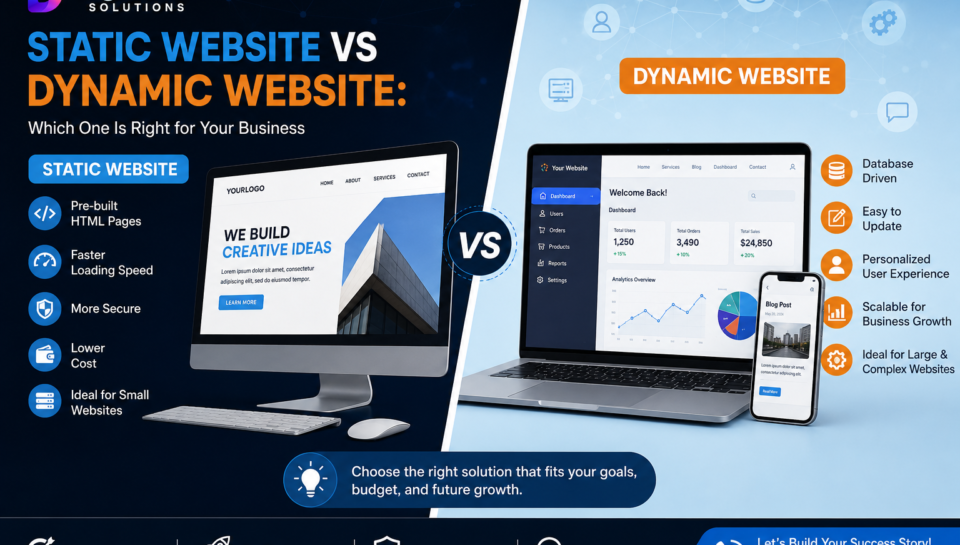
Static Website vs Dynamic Website: Which One Is Right for Your Business
When you sit down with a web developer in India and tell them you need a website, one of the first decisions that comes up — sometimes without being explained properly — is whether you need a static or dynamic website.
Most business owners nod along and let the developer decide. That’s not always a bad outcome, but it helps to understand what you’re actually choosing between — because the decision affects your cost, your flexibility, your maintenance requirements, and how your website performs on Google.
This guide explains both options clearly, without technical jargon, so you can make an informed decision before the first line of code is written.
What Is a Static Website
A static website is built with fixed content. Every visitor who opens a page sees exactly the same thing — the same text, the same images, the same layout. The content doesn’t change based on who is viewing it, when they’re viewing it, or what they’ve done on the site before.
Static websites are built using HTML and CSS at their core. They’re simple by design — each page is a file that gets delivered to the browser exactly as it was written, with nothing happening in between.
Think of a static website like a printed brochure. It looks good, delivers information clearly, and does its job well — but once it’s printed, the content is fixed until you print a new version.
What Is a Dynamic Website
A dynamic website generates content on the fly. When a visitor loads a page, the website pulls information from a database, processes it, and builds the page in real time based on who is visiting, what they’ve searched for, what they’ve bought before, or what content is currently available.
WordPress websites are dynamic. E-commerce stores are dynamic. News portals, booking platforms, membership sites, and any website where content changes regularly — all dynamic.
Think of a dynamic website like a restaurant menu board that updates automatically based on what’s available today, who’s ordering, and what the daily specials are. The structure stays the same but the content adapts.
Static vs Dynamic Website: Side by Side Comparison
| Factor | Static Website | Dynamic Website |
|---|---|---|
| Content | Fixed — same for every visitor | Changes based on user, time, or database |
| Technology | HTML, CSS, basic JavaScript | CMS (WordPress), databases, server-side code |
| Development time | Faster — days to weeks | Longer — weeks to months |
| Development cost | Lower | Higher |
| Maintenance | Minimal | Regular updates needed |
| Page speed | Very fast — no database queries | Can be slower without optimisation |
| Ease of editing | Requires developer for content changes | Owner can update content themselves |
| Scalability | Limited — not suited for large content volume | Highly scalable |
| SEO capability | Good for targeted, lean pages | Excellent with proper setup |
| Best for | Brochure sites, portfolios, landing pages | Blogs, e-commerce, portals, service businesses with regular updates |
| Security | More secure — fewer attack surfaces | Needs regular security maintenance |
| Hosting cost | Lower — can use simple hosting | Higher — needs more server resources |
When a Static Website Makes Sense for Your Business
A static website is the right choice when your content doesn’t change often, your site is relatively small, and your primary goal is a fast, clean online presence that represents your business professionally.
Portfolio websites — Photographers, designers, architects, and freelancers who want to showcase their work without regular updates. The content stays largely the same and speed matters more than flexibility.
Single service businesses — A plumber, electrician, or home tutor who needs a simple site with their services, contact details, and a few testimonials. No blog, no product catalogue, no user accounts — just a clean professional presence.
Landing pages and campaign pages — Pages built for a specific promotion or ad campaign where the goal is one action and the content rarely changes. Static builds are faster and leaner for this purpose.
Early stage startups — Businesses that need to establish a web presence quickly while they figure out their full digital strategy. A static site gets them live fast and cheap, with the option to rebuild once requirements are clearer.
Event pages — A conference, wedding, or product launch page with fixed information about dates, location, and registration details.
When a Dynamic Website Makes Sense for Your Business
A dynamic website is the right choice when your content changes regularly, you want to manage the site yourself without developer involvement, or your business model requires features that static sites simply can’t support.
Service businesses with active blogs — Any business using content marketing as an SEO strategy needs a dynamic CMS. Adding blog posts, updating service pages, and managing content regularly is far easier on a platform like WordPress than editing static HTML files.
E-commerce stores — Online shops need dynamic websites by definition. Product catalogues, inventory management, user accounts, shopping carts, payment gateways — none of this is possible on a static website.
Businesses with multiple locations or service areas — If you need separate pages for each city or locality you serve, a dynamic CMS makes managing and scaling that content realistic without needing a developer for every update.
Educational platforms and coaching institutes — Course listings, student portals, batch schedules, and admission forms all require dynamic functionality.
Clinics and appointment-based businesses — Online booking systems, doctor profiles, and patient information pages that update regularly need a dynamic backend.
The Cost Difference: What to Expect in India
One of the most practical differences between static and dynamic websites is cost — both upfront and ongoing.
| Cost Factor | Static Website | Dynamic Website |
|---|---|---|
| Development cost | ₹8,000 – ₹25,000 | ₹25,000 – ₹1,00,000+ |
| Hosting cost per year | ₹1,500 – ₹5,000 | ₹5,000 – ₹20,000 |
| Maintenance cost | Minimal | ₹3,000 – ₹10,000/month |
| Content update cost | Developer needed each time | Self-manageable on CMS |
| Plugin/theme cost | None | ₹0 – ₹15,000/year |
The lower upfront cost of a static website can be appealing, but factor in what happens when you want to add a blog, update your services, or change your team page six months later. If every small content change requires a developer, those costs add up quickly.
A dynamic website costs more initially but gives you the independence to manage your own content — which saves money and time in the long run for most active businesses.
What About SEO — Does One Rank Better Than the Other
This is a question almost every business owner asks, and the answer is more nuanced than most people expect.
Static websites have a natural speed advantage. Because there’s no database query happening when a page loads, static pages deliver content to the browser faster. Page speed is a ranking factor, so a well-built static website can have a technical edge in this area.
However, dynamic websites — particularly WordPress — have a significant content advantage. The ability to publish blog posts regularly, create category pages, build internal linking structures, and manage large volumes of optimised content gives dynamic sites far more SEO surface area over time.
For a business that publishes content regularly and wants to rank for multiple keywords across many pages, a dynamic website will almost always outperform a static one over a 12-month period, even if the static site loads slightly faster.
The best SEO outcome comes from a dynamic website that is also properly speed-optimised — caching enabled, images compressed, a CDN in place, and unnecessary plugins removed.
A Common Mistake Businesses in India Make
Many small businesses in India are sold dynamic WordPress websites when a static site would have served them perfectly well — simply because the agency charges more for WordPress development.
Equally, some businesses are sold basic static sites when they clearly need a CMS — leaving them dependent on a developer for every content change and unable to run a blog or update their services without paying each time.
The right answer depends entirely on your business needs, content plans, and how involved you want to be in managing your own website. An honest web development agency will ask you these questions before recommending a platform — not after.
FAQs
1. Can a static website be converted to a dynamic website later?
Yes, but it’s essentially a rebuild rather than a conversion. The design elements and content can be carried over, but the underlying structure changes completely when moving from static HTML to a CMS like WordPress. If you think you’ll need dynamic features within a year or two, it’s often more cost-effective to build on a CMS from the start rather than rebuilding later.
2. Is WordPress always a dynamic website?
Standard WordPress is dynamic — it uses a database and server-side processing to build pages. However, there are tools that can generate static versions of WordPress sites for faster delivery, combining the content management benefits of WordPress with the speed advantages of static delivery. This is a more advanced setup typically used by larger or more technically sophisticated websites.
3. Which type of website is more secure — static or dynamic?
Static websites are generally more secure because there’s no database, no login system, and no server-side code that can be exploited. Dynamic websites — especially WordPress — require regular security maintenance, strong passwords, updated plugins, and security monitoring. That said, a well-maintained dynamic website is perfectly secure for most business purposes.
4. Can a static website have a contact form?
Yes. Contact forms on static websites use third-party services like Formspree, Netlify Forms, or EmailJS to handle form submissions without needing a server-side backend. This works well for simple enquiry forms, though more complex form logic requires a dynamic setup.
5. My business is very small — do I even need a dynamic website?
Not necessarily. If your website will have fewer than 10 pages, you don’t plan to blog regularly, and you just need a clean professional presence with your services and contact details, a static website is a perfectly sensible choice. Start lean, establish your online presence, and upgrade to a dynamic CMS when your content needs genuinely require it.
6. Which loads faster — static or dynamic websites?
Static websites are inherently faster because pages are pre-built and served directly without database queries. However, a well-optimised dynamic website with caching, a CDN, and compressed images can achieve load times that are competitive with static sites. The gap is real but can be largely closed with proper performance optimisation on a dynamic build.
Final Thoughts
Static and dynamic websites are not competing products where one is clearly better than the other. They’re different tools built for different purposes — and choosing between them should come down to what your business actually needs, not what sounds more impressive or costs more.
If you need a clean, fast, low-maintenance online presence for a small business or single service, a static website is a smart, cost-effective choice. If you need to manage content regularly, run a blog, operate an online store, or scale your digital presence over time, a dynamic website — built and optimised correctly — is worth every additional rupee.
The most important thing is to have this conversation with your web development agency before the project starts. Know what you’re getting, why you’re getting it, and how it serves your business goals. A website built on the right foundation from day one will always outperform one that was built quickly and rebuilt expensively six months later.