

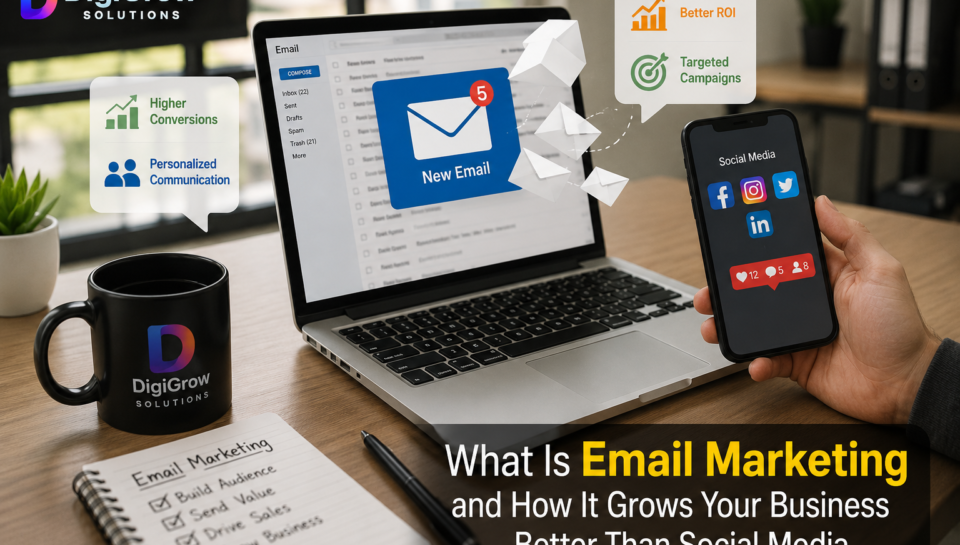
What Is Email Marketing and How It Grows Your Business Better Than Social Media
Every business owner in India is on Instagram. Most are on Facebook. Many have tried YouTube. And almost every one of them is frustrated by the same thing — declining organic reach, inconsistent results, and the constant pressure to create content for algorithms that change without warning.
Meanwhile, the businesses quietly generating consistent leads and repeat sales every single month are often doing it through a channel most people dismissed years ago as outdated.
Not because email is glamorous. Not because it generates viral moments or follower counts you can show off. But because it works — consistently, measurably, and at a fraction of the cost of almost every other digital marketing channel available to small businesses in India today.
This guide explains what email marketing actually is, why it outperforms social media for most business goals, and exactly how to get started even if you have zero technical experience and a very modest budget.
What Is Email Marketing
Email marketing is the practice of sending targeted, intentional emails to a list of people who have expressed interest in your business — subscribers, past customers, leads who filled out a form, or attendees of an event you hosted.
Unlike a cold email sent to strangers, email marketing works with permission. Someone gives you their email address because they want to hear from you — because you offered them something valuable, because they bought from you, or because they signed up to learn more about what you do.
That permission is what makes email marketing fundamentally different from social media, paid ads, or cold outreach. You are not interrupting a stranger. You are continuing a conversation with someone who already knows who you are and chose to stay in touch.
Email marketing covers a wide range of communication types:
| Email Type | Purpose | Example |
|---|---|---|
| Welcome email | Introduce new subscribers to your business | “Thanks for signing up — here’s what we do” |
| Newsletter | Share updates, tips, and content regularly | Weekly industry insights or business updates |
| Promotional email | Drive sales or enquiries with a specific offer | “20% off this week only for subscribers” |
| Nurture sequence | Build trust with leads over time automatically | 5-email series educating a prospect before they buy |
| Transactional email | Confirm orders, bookings, or account actions | “Your appointment is confirmed for Tuesday” |
| Re-engagement email | Reconnect with inactive subscribers | “We miss you — here’s something for coming back” |
| Announcement email | Share news about your business | New service launch, new team member, new location |
Why Email Marketing Outperforms Social Media for Most Business Goals
This is the comparison most marketing guides avoid making directly — because agencies that manage social media don’t want to tell you that email often delivers better results for less money.
Here is the honest comparison:
| Factor | Email Marketing | Social Media Marketing |
|---|---|---|
| Reach | Near 100% — emails go to every subscriber | 2% to 10% organic reach on most platforms |
| Ownership | You own your list completely | Platform owns your followers |
| Algorithm dependency | None — email goes directly to inbox | Entirely algorithm dependent |
| Average ROI | Among the highest of any marketing channel | Highly variable, often difficult to measure |
| Cost per message | Near zero after list is built | Increasing as organic reach declines |
| Personalisation | Highly personalised by name, behaviour, purchase history | Limited personalisation in organic posts |
| Longevity | Emails can be opened days or weeks later | Posts disappear from feeds within hours |
| Customer relationship | Direct, personal, one-to-one feel | Public, broadcast, one-to-many |
| Measurability | Open rates, click rates, conversions — precise | Reach, likes, comments — often vanity metrics |
| Risk | Low — you control the channel | High — platform can ban account or change algorithm |
The single most important point in that table is ownership. Your Instagram followers, your Facebook page likes, your YouTube subscribers — none of those belong to you. They belong to the platform. If Instagram changes its algorithm tomorrow, or if your account gets restricted, you lose access to that audience instantly with no recourse.
Your email list belongs to you. Nobody can take it away. No algorithm change can reduce how many of your subscribers receive your emails. That ownership is the foundation that makes email marketing the most stable long-term marketing channel available to any business.
The Reality of Social Media Organic Reach in India in 2026
Let’s be specific about what organic reach actually looks like on major platforms today.
A Facebook page with 10,000 followers typically reaches 500 to 1,000 people with an organic post — 5% to 10% reach on a good day, and often less. Instagram reach has been declining steadily as the platform prioritises Reels and paid content. Even WhatsApp broadcast lists, while still highly effective, are limited to contacts who have saved your number.
Compare this to email — where the average open rate across industries is 35% to 45%, meaning if you have a list of 1,000 subscribers, 350 to 450 of them will actually read what you send.
That difference in reach — 5% to 10% on social media versus 35% to 45% via email — is the core reason email marketing generates more direct business results per message sent than organic social media for most businesses.
How to Build an Email List From Scratch in India
The most common reason Indian businesses don’t do email marketing is that they don’t have a list. The solution is simpler than most people think.
Start with who you already know
Your existing customers, past enquiries, people who have contacted you via WhatsApp, attendees of events you’ve held — these people already know and trust your business. With their permission, this becomes your founding list. Even 50 engaged subscribers who genuinely want to hear from you is a more valuable starting point than 5,000 social media followers who barely remember following you.
Add a signup form to your website
Every page of your website should have an opportunity for visitors to subscribe to your email list. A simple form in your website header, footer, or as a popup offering something valuable in exchange for an email address — a free guide, a discount, a useful checklist — converts website visitors into subscribers who have explicitly opted in to hear from you.
Offer a lead magnet
A lead magnet is something genuinely useful you give away free in exchange for an email address. For an Indian digital marketing agency, this might be a free SEO checklist. For a dental clinic, it could be a PDF guide on maintaining oral health at home. For a coaching institute, a free sample class or study plan. The lead magnet should solve a specific small problem for your target customer and be valuable enough that they’d happily trade their email address for it.
Use your social media to grow your list
Post your lead magnet offer on Instagram and Facebook. Run a low-budget Meta ad promoting your free resource and collecting email addresses through a landing page. Social media and email marketing work best together — use social media’s reach to build your email list, then use email to nurture those leads more effectively than social media alone ever could.
Collect emails at every customer touchpoint
In-store, at events, after service delivery, during consultations — any moment where a customer is happy and engaged is an opportunity to invite them onto your list. A simple “Would you like to receive our monthly tips and offers by email?” converts better than you might expect when asked at the right moment.
How to Write Emails That People Actually Open and Read
Building a list is only half the challenge. The other half is sending emails that subscribers open, read, and act on.
The subject line is everything
Your subject line determines whether your email gets opened or ignored. In a crowded inbox, you have one line of text to earn a click. The best subject lines are specific rather than vague, create curiosity or urgency without being manipulative, and speak directly to something the subscriber cares about.
Weak subject line: “Our Monthly Newsletter”
Strong subject line: “3 reasons your website isn’t getting enquiries (and how to fix them)”
Write like a person, not a corporation
The emails that get the best open rates and click rates read like they were written by a real human being to another real human being — not like a press release or a brochure. Use the subscriber’s first name. Write in first person. Be direct. Be conversational. Share a real observation, a real challenge, a real story. The closer your email feels to a personal message from someone the subscriber trusts, the more it will be read and acted upon.
One email, one goal
Every email you send should have one clear purpose — drive traffic to a blog post, promote a specific service, invite subscribers to book a consultation, share one useful piece of advice. Emails that try to do five things at once end up doing none of them effectively. Pick one goal, build the email around that goal, and make the call to action obvious.
Keep it readable
Short paragraphs. Clear sections. A single prominent call to action button or link. Most subscribers scan emails before deciding whether to read them properly — your formatting should make the key message and the desired action visible even to someone who only spends 10 seconds scanning.
Best Email Marketing Tools for Indian Businesses in 2026
You don’t need expensive software to start email marketing. Several excellent platforms offer free tiers that are more than sufficient for small businesses just starting out.
| Tool | Free Plan | Best For | Paid Plans From |
|---|---|---|---|
| Mailchimp | Up to 500 contacts, 1,000 emails/month | Beginners, small lists | ~₹800/month |
| Brevo (formerly Sendinblue) | Unlimited contacts, 300 emails/day | Growing businesses | ~₹1,500/month |
| MailerLite | Up to 1,000 contacts, 12,000 emails/month | Small businesses, bloggers | ~₹900/month |
| ConvertKit | Up to 1,000 subscribers | Content creators, coaches | ~₹2,500/month |
| Zoho Campaigns | Up to 2,000 contacts, 6,000 emails/month | Businesses already using Zoho | ~₹700/month |
For most small businesses in India starting email marketing, MailerLite or Brevo offer the most generous free tiers with professional features including automation, landing pages, and detailed analytics.
Email Automation: The Feature That Makes Email Marketing Scale
The most powerful feature of email marketing — and the one that separates it most dramatically from social media — is automation.
Email automation allows you to set up sequences of emails that are sent automatically based on triggers — someone subscribes to your list, someone makes a purchase, someone clicks a specific link, someone hasn’t opened an email in 60 days.
A simple automated welcome sequence for a digital marketing agency might look like this:
Day 1 — Welcome email introducing the agency, what they do, and what subscribers can expect to receive.
Day 3 — A genuinely useful email sharing the agency’s top three tips for small businesses to improve their Google ranking — no sales pitch, just value.
Day 7 — A case study or success story from a real client — specific results, the challenge they faced, how the agency helped.
Day 14 — A soft invitation to book a free consultation, with a simple link to a booking form.
This sequence runs automatically for every new subscriber without any manual effort after the initial setup. The business owner writes it once and it works indefinitely — nurturing every new lead through a trust-building journey that ends with a clear invitation to take the next step.
That is something no social media platform can replicate at any budget.
Email Marketing Strategy for Different Business Types in India
| Business Type | List Building Strategy | Email Content Focus |
|---|---|---|
| Digital marketing agency | Free SEO audit, lead magnet guides | Tips, case studies, service offers |
| Dental clinic | Free oral health guide, appointment booking | Health tips, appointment reminders, offers |
| Coaching institute | Free sample class, study material | Course updates, success stories, admissions |
| E-commerce store | Discount on first order | Product launches, offers, abandoned cart |
| CA or legal firm | Free tax calendar, compliance checklist | Regulatory updates, service announcements |
| Restaurant | Loyalty programme signup | Weekly specials, events, birthday offers |
| Real estate agency | Free area price guide | New listings, market updates, investment tips |
What Results Should You Realistically Expect
Email marketing is not an overnight solution. Building a quality list and developing an engaged audience takes consistent effort over months. Here is a realistic timeline for a small business in India starting from zero:
Month 1 to 2 — Set up your email platform, create your signup form, import existing contacts with permission, and send your first newsletter. Focus on delivering genuine value rather than selling. List size: 50 to 200 subscribers.
Month 3 to 4 — Establish a consistent sending schedule — weekly or fortnightly. Create your first automated welcome sequence. Promote your lead magnet on social media and your website. List size: 200 to 500 subscribers.
Month 5 to 6 — Begin segmenting your list based on subscriber behaviour and interests. Test different subject lines and email formats. List size: 500 to 1,000 subscribers.
Month 6 and beyond — Consistent open rates of 30% to 45%, regular click-throughs to your website and offers, and measurable impact on enquiries and sales. Email becomes your most reliable owned marketing channel.
FAQs
1. Is email marketing legal in India?
Yes, email marketing is legal in India provided you have explicit consent from subscribers — meaning they actively opted in to receive emails from you. Sending unsolicited bulk emails without consent violates the Information Technology Act and India’s spam regulations. Always use confirmed opt-in signup forms and include a clear unsubscribe link in every email you send. Never purchase email lists — this practice violates most email platform terms of service and Indian data protection principles under the Digital Personal Data Protection Act 2023.
2. How often should I send marketing emails to my list?
For most small businesses in India, once a week or once a fortnight is the right frequency. Too infrequent — once a month or less — and subscribers forget who you are and why they signed up, leading to low open rates and high unsubscribe rates when you do send. Too frequent — daily emails without a clear reason — causes subscriber fatigue and unsubscribes. Consistency matters more than frequency — whatever schedule you choose, stick to it so subscribers know when to expect to hear from you.
3. What is a good email open rate for Indian businesses?
A healthy open rate for small business email lists in India is typically between 25% and 45%, depending on the industry and how engaged your list is. Lists built through genuine relationship-building and valuable content consistently outperform lists grown primarily through incentives or paid advertising. If your open rate is consistently below 20%, focus on improving subject lines, cleaning inactive subscribers from your list, and reviewing whether your content is genuinely serving your audience’s interests.
4. Can email marketing work for B2B businesses in India?
Email marketing is arguably even more effective for B2B businesses than B2C. Business decision-makers check email consistently throughout the day, respond to professional communication, and value detailed information that helps them make better business decisions. A B2B email list of 500 genuinely engaged prospects in your industry is worth significantly more to a service business than 10,000 social media followers with low engagement and unclear purchase intent.
5. What should I write about in my business emails?
Write about what your customers and prospects genuinely care about — not what you want to sell them. Useful tips related to your industry, answers to questions your customers frequently ask, behind-the-scenes insights into how your business works, relevant news or changes in your industry, success stories from real customers, and occasional direct offers when you have something genuinely valuable to promote. The 80/20 rule works well — 80% genuinely useful content, 20% direct promotion.
6. How is email marketing different from WhatsApp marketing for Indian businesses?
Both are direct communication channels with high engagement rates, but they serve different purposes and have different strengths. WhatsApp marketing is more immediate and conversational — better for quick updates, appointment reminders, and direct customer service interactions. Email marketing is better suited to longer content, detailed newsletters, automated nurture sequences, and professional business communication. Most Indian businesses benefit from using both — WhatsApp for immediate, informal communication and email for structured, value-driven marketing that builds long-term relationships.
Final Thoughts
Social media is where your audience spends time. Email is where they make decisions.
The businesses in India that grow most consistently online are not necessarily the ones with the most Instagram followers or the most viral content. They are the ones that have built a direct line of communication with their best prospects and customers — a line that no algorithm controls, no platform can shut down, and no competitor can interrupt.
Email marketing gives you that line.
Start small — collect 50 genuine email addresses from people who actually want to hear from you, send them something genuinely useful once a fortnight, and build from there. The list that feels insignificant today is the asset that generates consistent business a year from now.
In a world where social media reach is declining, ad costs are rising, and attention is harder to earn than ever, owning a direct channel to your audience is not a nice-to-have. It is one of the most valuable things a small business in India can build in 2026.