


How to Create a Digital Marketing Strategy for Small Business in India From Scratch
Most small business owners in India know they need digital marketing. Very few know where to actually start.
They try Instagram for a few weeks, get no results, move to Google Ads, burn through a budget without understanding why it didn’t work, hear about SEO, try that for a month, and then give up — convinced that digital marketing is either too expensive or too complicated for a business their size.
The problem was never the individual tactics. The problem was starting without a strategy.
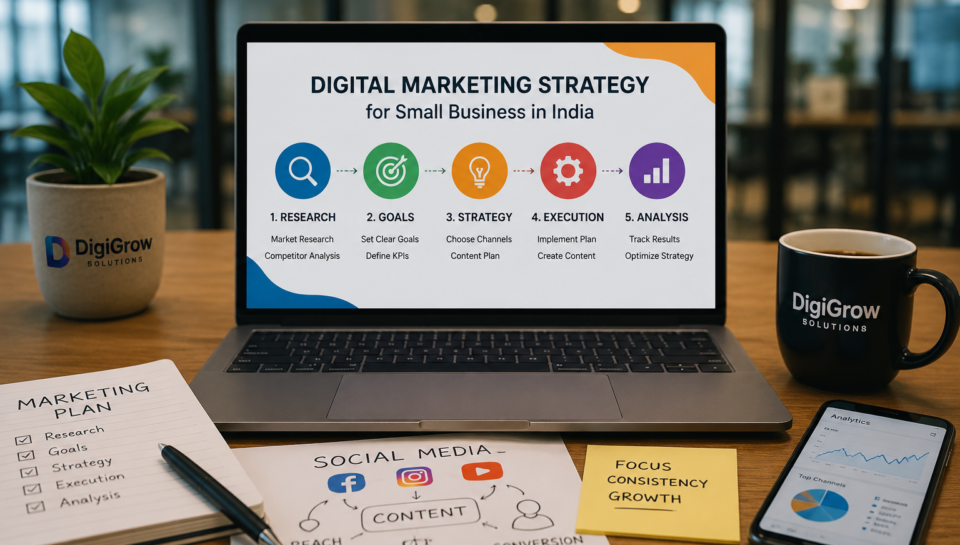
A digital marketing strategy is not a complicated document. It’s a clear answer to four questions: who are you trying to reach, where do they spend time online, what do you want them to do, and how will you measure whether it’s working. Everything else builds from those answers.
This guide walks you through building that strategy from scratch — specifically for small businesses in India, with realistic budgets and practical steps.
Step 1: Define Your Business Goals Before Touching Any Platform
Every digital marketing decision you make should trace back to a specific business goal. Without this foundation, you end up doing random things across random platforms and wondering why nothing moves.
Your goals need to be specific and measurable. Not “get more customers” but “generate 20 enquiries per month through the website within 90 days.” Not “grow on Instagram” but “reach 5,000 followers in our target city within 6 months.”
Common digital marketing goals for small businesses in India:
| Goal Type | Example |
|---|---|
| Lead generation | Get 30 enquiries per month from Google |
| Brand awareness | Reach 10,000 local people on social media monthly |
| Website traffic | Grow organic visitors from 500 to 2,000 per month |
| Local visibility | Rank in top 3 on Google Maps for primary service keyword |
| Sales | Generate ₹2,00,000 in monthly online revenue |
| Reputation building | Collect 50 genuine Google reviews within 3 months |
Write down your top two goals. Everything in your strategy should serve those two goals directly. If an activity doesn’t connect to either goal, it’s a distraction — not a strategy.
Step 2: Understand Your Target Audience Deeply
The biggest mistake small businesses make in digital marketing is trying to reach everyone. When you try to speak to everyone, you end up connecting with no one.
Your target audience is the specific group of people most likely to need what you offer, have the budget to pay for it, and be reachable through digital channels. The more precisely you define this group, the more effective every marketing rupee you spend becomes.
Build a simple customer profile by answering these questions:
— How old are they and where do they live?
— What is their profession or income level?
— What problem are they trying to solve that your business addresses?
— Where do they spend time online — Google, Instagram, YouTube, LinkedIn, WhatsApp?
— What do they search for when they’re looking for a business like yours?
— What objections do they have before buying — price, trust, alternatives?
For a digital marketing agency in Lucknow, the target audience might be small business owners aged 28 to 50 in Uttar Pradesh who want more customers online but don’t know how to do it themselves. They search Google for things like “affordable SEO services Lucknow” and spend time on Instagram and YouTube. Their main objection is whether the agency will actually deliver results.
That level of specificity changes everything — from which platforms you focus on to what content you create to how you write your ads.
Step 3: Audit Your Current Digital Presence
Before building anything new, take stock of what already exists. Most small businesses have some digital presence — a Facebook page, a Google Business Profile, maybe a basic website — but haven’t connected any of it into a coherent strategy.
Check each of the following:
Website — Does it exist? Is it mobile-friendly? Does it load quickly? Is it optimised for any keywords? Does it have a clear call to action?
Google Business Profile — Is it claimed and verified? Is it fully filled in? How many reviews does it have? When was the last photo added?
Social Media — Which platforms are you on? When did you last post? What engagement do existing posts get?
Google Search Console — Is it set up? What keywords is your site currently ranking for, even weakly?
Online Reviews — How many reviews do you have across Google, Justdial, and other platforms? What is your average rating?
This audit gives you a baseline and immediately reveals the biggest gaps to fix first. A business with no Google Business Profile should fix that before spending money on Instagram ads. A business whose website takes 10 seconds to load should fix that before investing in SEO content.
Step 4: Choose the Right Digital Marketing Channels
Not every business needs to be on every platform. Choosing the right two or three channels and executing them well beats spreading yourself thin across six platforms and doing all of them poorly.
Here’s how to think about channel selection for Indian small businesses:
Google Search (SEO) — Best for businesses where customers actively search for the service. Dentists, lawyers, web developers, chartered accountants, repair services — anyone whose customers type a need into Google. Results take 3 to 6 months but compound over time and generate free traffic indefinitely.
Google Business Profile (Local SEO) — Essential for any business with a physical location or local service area. Free to use, high conversion intent, and often the fastest path to more local customers for service businesses.
Instagram and Facebook — Best for businesses with a visual product or service, or those targeting consumers rather than businesses. Restaurants, salons, clothing brands, interior designers, event planners. Works well for both organic content and paid ads.
YouTube — Best for businesses where education builds trust — coaching institutes, financial advisors, healthcare professionals, software companies. Long-form video content that demonstrates expertise converts exceptionally well for high-consideration purchases.
LinkedIn — Best for B2B businesses targeting professionals, companies, or corporate clients. Digital agencies, HR firms, software companies, training institutes targeting working professionals.
WhatsApp Marketing — Underutilised but extremely effective for Indian small businesses. Direct, personal, and has far higher open rates than email. Works well for follow-up, offers, and maintaining relationships with existing customers.
Google Ads and Meta Ads — Best for businesses that need immediate traffic and have a clear offer. Requires budget and a well-designed landing page to convert effectively. Not a substitute for SEO — a complement to it.
For most small businesses in India just starting out, the recommended starting point is: Google Business Profile optimisation first, then a basic SEO-ready website, then one social media platform relevant to your audience, then content creation. Paid ads come later, once the organic foundation is in place.
Step 5: Build Your Content Plan
Content is the fuel that powers every digital marketing channel. SEO needs content to rank. Social media needs content to engage. Google Ads needs landing page content to convert. Email marketing needs content to nurture.
A content plan doesn’t need to be complicated. For a small business starting out, it can be as simple as:
— Two blog posts per month targeting specific search keywords
— Three to four social media posts per week
— One Google Business Profile post per week
— One email or WhatsApp broadcast per month to existing customers
The key is consistency over volume. Two well-written, properly optimised blog posts every month will do more for your SEO over 12 months than twenty rushed posts published in January and nothing after.
Every piece of content you create should serve a specific purpose — either to rank for a keyword, to build trust with your audience, to generate a direct enquiry, or to keep existing customers engaged.
Step 6: Set a Realistic Budget
One of the most common questions from small business owners in India is how much digital marketing should cost. The honest answer is that it depends on your goals, timeline, and how much of the work you do yourself versus outsourcing.
Here’s a realistic budget breakdown for a small business in India starting digital marketing:
| Activity | DIY Cost | Agency Cost Per Month |
|---|---|---|
| Google Business Profile optimisation | Free | ₹3,000 – ₹8,000 |
| Basic SEO (on-page + content) | Free tools only | ₹8,000 – ₹25,000 |
| Social media management | Free | ₹5,000 – ₹15,000 |
| Google Ads management | Ad spend only | ₹5,000 – ₹15,000 (+ ad spend) |
| Meta Ads management | Ad spend only | ₹5,000 – ₹12,000 (+ ad spend) |
| Website maintenance | Free if self-managed | ₹3,000 – ₹8,000 |
A realistic starting budget for a small business in India working with a digital marketing agency is ₹15,000 to ₹30,000 per month, covering SEO, social media, and Google Business Profile management. Paid advertising budgets are additional and should start at a minimum of ₹10,000 per month in ad spend to generate meaningful data.
Step 7: Measure What Matters and Adjust Monthly
A digital marketing strategy that isn’t measured isn’t a strategy — it’s guesswork. You need to track specific metrics that connect to your business goals and review them at least once a month.
| Goal | Metrics to Track |
|---|---|
| Lead generation | Number of form submissions, calls, WhatsApp enquiries |
| SEO growth | Organic traffic, keyword rankings, impressions in GSC |
| Local visibility | Google Maps views, direction requests, profile calls |
| Social media | Reach, engagement rate, profile visits, link clicks |
| Paid ads | Cost per click, conversion rate, cost per lead |
| Overall | Total leads, lead source breakdown, cost per acquisition |
Use Google Analytics 4 for website traffic, Google Search Console for SEO performance, and your ad platform dashboards for paid campaign metrics. Review these numbers monthly, identify what’s working and what isn’t, and adjust your focus accordingly.
Digital marketing rewards consistency and adaptation. The businesses that grow fastest are not the ones with the biggest budgets — they’re the ones that measure, learn, and improve every single month.
Common Digital Marketing Mistakes Small Businesses in India Make
Understanding what not to do is just as valuable as knowing what to do:
Trying every platform at once — Spreading too thin produces mediocre results everywhere. Master one or two channels before adding more.
Expecting immediate results from SEO — SEO is a 3 to 6 month game minimum. Businesses that give up after 6 weeks miss the compounding results that come later.
Running ads without a proper landing page — Sending ad traffic to a poorly optimised homepage wastes budget. Build a dedicated landing page before spending on ads.
Posting without a content strategy — Random posts with no keyword focus, no audience targeting, and no clear goal generate engagement but rarely generate customers.
Not collecting reviews — Reviews are one of the highest-converting trust signals in Indian digital marketing. Most businesses have far fewer than they could with a simple, consistent ask process.
Ignoring WhatsApp — India has one of the highest WhatsApp usage rates in the world. A well-maintained WhatsApp broadcast list of existing customers is one of the cheapest and most effective marketing channels available to any small business.
FAQs
1. How long does it take to see results from digital marketing for a small business in India?
It depends on the channel. Google Business Profile optimisation can show results within 4 to 6 weeks. SEO typically takes 3 to 6 months for meaningful ranking movement. Social media organic growth takes 3 to 9 months of consistent effort. Paid ads can generate leads within days but require ongoing budget. Most small businesses see a meaningful overall improvement in leads and visibility within 6 months of implementing a consistent strategy.
2. Can I do digital marketing myself without hiring an agency?
Yes, especially in the early stages. Setting up and optimising your Google Business Profile, creating social media content, writing basic blog posts, and managing a WhatsApp broadcast list are all things a business owner can do without technical expertise. The advantage of an agency comes in areas like technical SEO, paid ad management, and scaling — where experience and tools make a significant difference in results and cost efficiency.
3. Which digital marketing channel gives the fastest results for a small business in India?
Google Ads and Meta Ads generate traffic immediately once campaigns are live, making them the fastest channel for lead generation. However, they require ongoing budget to maintain. Google Business Profile optimisation is the fastest free channel — a fully optimised profile with good reviews can start appearing in local search results within weeks. SEO and organic social media take longer but generate compounding results that paid channels don’t.
4. How much should a small business in India spend on digital marketing?
A reasonable starting point is 5% to 10% of your monthly revenue allocated to marketing. For a business generating ₹3,00,000 per month, that’s ₹15,000 to ₹30,000 for digital marketing activities. As you measure what channels deliver the best return, you can shift budget toward the highest-performing activities and increase total spend as revenue grows.
5. Do I need a website to start digital marketing in India?
A website is not strictly necessary to start — you can generate enquiries through your Google Business Profile, Instagram, and WhatsApp without one. However, a website significantly improves every other digital marketing channel. It gives your ads a destination that converts, gives SEO a platform to build on, and gives potential customers a place to verify your credibility before reaching out. For any business planning serious digital marketing, a basic website should be one of the first investments.
6. What is the most important digital marketing channel for local businesses in India?
Google Business Profile is consistently the highest-impact starting point for local businesses in India — clinics, shops, service providers, restaurants, and any business that serves a specific city or area. It’s free, directly connected to Google Maps and local search results, and attracts visitors with extremely high purchase intent. After GBP, local SEO on your website and a consistent review collection process round out the most effective local digital marketing foundation.
Final Thoughts
Digital marketing works for small businesses in India. Not because of big budgets or complex tools — but because the businesses that grow online consistently do a handful of simple things well, measure what matters, and keep showing up.
The strategy doesn’t need to be complicated. Know who you’re trying to reach. Be where they are online. Give them a reason to trust you. Make it easy for them to take action. Track what’s working and do more of it.
Start with your Google Business Profile. Build a basic SEO-ready website. Pick one social media platform and post consistently. Write one useful blog post every two weeks. Collect reviews from every happy customer. Do those five things for six months without stopping, and your business will look completely different on Google than it does today.
The businesses that dominate local digital marketing in India in 2026 are not the ones who tried everything — they’re the ones who committed to the basics and executed them better than anyone else in their market.