


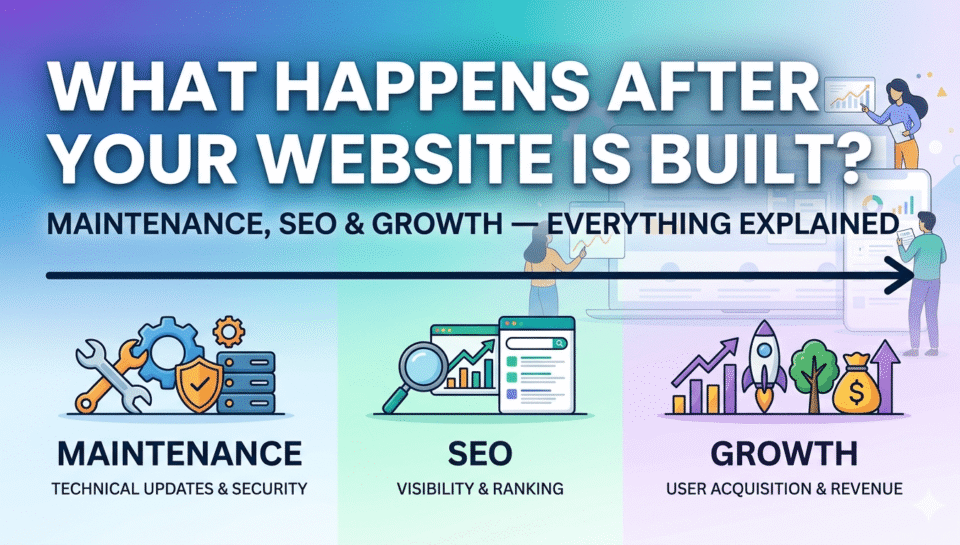
What Happens After Your Website Is Built? Maintenance, SEO & Growth — Everything Explained
The Website Is Live. Everyone Celebrates. Then What?
You spent weeks going back and forth on the design. You wrote the content, sent over your logo, approved the final version, and watched your developer hit publish.
Your website is live.
For most small business owners in India, that moment feels like the finish line. The hard part is done. Now customers will find you, inquiries will come in, and business will grow.
Except — that is not quite how it works.
A website going live is not the end of the process. It is the beginning of a completely different one. And the businesses that understand this are the ones that actually see results. The ones that do not — they end up with a website that sits there for two years, brings in almost nothing, and eventually gets hacked or breaks without anyone noticing.
This guide is for anyone who has a website that just launched, or is about to launch, or has been live for a while with no clear plan. We are going to walk through exactly what needs to happen after your website goes live — step by step, in plain language.
Step 1 — The First 48 Hours: Technical Setup You Cannot Skip
The moment your website goes live, there are a few technical things that need to happen immediately. These are not optional. They are the foundation everything else is built on.
Submit Your Website to Google
Your website does not automatically appear on Google the day it launches. Google needs to discover it, crawl it, and index it — and this process can take anywhere from a few days to several weeks if you do nothing.
The fastest way to speed this up is to submit your website to Google Search Console. This is a free tool from Google that lets you tell Google your website exists, submit your sitemap, and monitor how Google sees your site. We set this up for every client we work with on launch day.
Set Up Google Analytics
Google Analytics tells you how many people are visiting your website, where they are coming from, which pages they are reading, and how long they are staying. Without it, you are completely blind — you have no idea whether your website is working or not.
Setting this up on day one means you start collecting data immediately. Six months from now, you will have real numbers to look at and real decisions to make based on actual behaviour, not guesswork.
Check Everything on Mobile
Pull out your phone — not the phone you normally use, but a different one if possible. Browse every page of your website. Check that all buttons work, all images load, all forms submit, and the layout looks correct. Mobile issues often only appear on specific devices or screen sizes and are missed during development.
Test All Contact Points
Fill in your contact form yourself. Send yourself a test inquiry. Make sure the email actually arrives. Check that your phone number is clickable and dials correctly. Verify that your WhatsApp link opens the right number. These are the most important elements on your website — if they are broken and you do not know, you are losing real inquiries every day.
Step 2 — The First Month: Getting Found on Google
Once the technical foundation is in place, the next priority is visibility. You want Google to understand who you are, what you do, and who you serve — so it can start showing your website to the right people.
Set Up and Optimise Your Google Business Profile
If you serve local customers — and most small businesses in India do — your Google Business Profile is the single highest-ROI thing you can do after your website launches. It is completely free.
A fully optimised Google Business Profile gets your business listed on Google Maps, appears in local “near me” searches, and shows your phone number, address, hours, photos, and reviews directly in Google search results — without anyone even clicking through to your website.
Fill in every field. Add real photos of your shop, office, or work. Write a proper business description with your city name and what you do. Add your services. Connect it to your website. This alone can start bringing in calls within weeks.
On-Page SEO — Make Sure Google Can Read Your Website
Your website needs to be written and structured in a way that Google can understand. This means each page has a clear title tag and meta description that includes the keywords your customers are actually searching for. Your headings use proper H1, H2, and H3 structure. Your images have alt text. Your URLs are clean and descriptive.
If your web developer handled this properly during the build, you are in good shape. If not — and many developers skip SEO during development — this needs to be addressed before you start any other marketing activity.
Write Your First Blog Post
One of the most effective long-term strategies for getting organic traffic from Google is publishing useful content on your website. Blog posts that answer real questions your customers ask — questions they type into Google — bring in visitors for months and years after they are published.
Your first blog post does not need to be perfect. It needs to be genuinely useful, properly structured, and relevant to your business. Pick one question your customers ask you all the time and write a thorough, honest answer.
Step 3 — Months 2 and 3: Building Consistency
The first month is about setup. Months two and three are about building a rhythm. Here is what that looks like in practice.
Publish Content Regularly
Google rewards websites that are regularly updated with fresh, useful content. This does not mean you need to post every day. Two well-written blog posts per month is enough to signal to Google that your website is active and worth crawling frequently.
The topics you write about should be directly connected to what your customers search for. A coaching centre in Lucknow should write about topics like “how to prepare for board exams” or “best study techniques for Class 10.” A clinic should write about common health questions their patients ask. A legal firm should explain common legal situations in plain language.
This is called content marketing and it is one of the most sustainable ways to build organic traffic without spending on ads.
Build Your Local Citations
Local citations are mentions of your business name, address, and phone number on other websites — business directories, industry listings, local chamber of commerce pages, and platforms like JustDial, Sulekha, and IndiaMART. Each consistent mention reinforces to Google that your business is legitimate and local.
Make sure your business name, address, and phone number are exactly the same on every platform — including your website and your Google Business Profile. Even small inconsistencies, like writing “Road” on one platform and “Rd.” on another, can confuse Google’s local ranking signals.
Start Collecting Reviews
Online reviews are one of the most powerful trust signals for both customers and Google. Ask every satisfied customer to leave a review on your Google Business Profile. Make it easy — send them the direct link via WhatsApp after a successful interaction.
Businesses with more positive reviews consistently rank higher in local search results and convert more visitors into inquiries. This is free and entirely within your control.
Step 4 — Months 4 to 6: Measuring and Improving
By this point, your website has been live for a few months, Google has indexed it, and you have some real data to work with. Now it is time to pay attention to what is actually happening.
Review Your Google Analytics Data
Look at which pages are getting the most traffic. Look at where visitors are dropping off. Look at whether people are actually filling in your contact form or just leaving. This data tells you what is working and what is not — and that tells you where to focus your energy next.
If a particular blog post is getting consistent traffic, write more content on similar topics. If your services page has a high bounce rate, review the content and make it clearer and more persuasive. If very few people are reaching your contact page, make sure every other page has a clear, prominent call to action pointing there.
Check Your Google Search Console for Issues
Google Search Console will show you if there are any crawl errors, pages that are not indexed, mobile usability issues, or Core Web Vitals problems. Address these promptly — they directly affect your ability to rank.
It will also show you which search queries are bringing people to your website. This is incredibly valuable. You will often discover that people are finding you for things you did not specifically target — and that tells you what content to create next.
Consider Paid Ads If You Need Faster Results
Organic SEO takes time. If your business needs leads now — not in six months — a small investment in Google Ads or Meta Ads can bridge the gap. Even ₹3,000–₹5,000 per month, spent on tightly targeted local ads, can generate meaningful results for a small business.
Paid ads and organic SEO work best together. Ads bring immediate visibility while your organic rankings grow. Once your organic traffic is strong, you can reduce or stop the ads if you choose.
Step 5 — Ongoing: Maintenance, Security, and Growth
A website is a living business asset. It needs ongoing attention — not just in the first six months, but permanently.
Monthly Maintenance Is Non-Negotiable
Every month, someone needs to update your WordPress core, plugins, and themes. Someone needs to run a security scan and check that no malware has been injected. Someone needs to verify that your backups are working, your SSL certificate is valid, and your contact forms are still functioning.
These are not dramatic tasks. But skipping them consistently leads to real problems — slow load times, security vulnerabilities, broken features, and eventually, a compromised or inaccessible website.
Keep Your Content Fresh
Outdated information on your website damages trust. If your phone number changed, update it everywhere. If your prices changed, update the website. If you added a new service, add it to your services page. If you won an award or completed a notable project, add it to your about page.
Google also notices when a website is updated regularly versus sitting stagnant. Fresh content is a positive ranking signal.
Evolve Your Website as Your Business Grows
Your website when you started is not the website you need two years from now. As your business grows, your website should grow with it — new pages for new services, a testimonials section once you have a body of client reviews, a case studies page once you have notable work to show, and potentially an e-commerce section if you start selling products online.
Think of your website not as a completed project but as an ongoing investment in your business’s visibility and credibility.
The Biggest Mistake Business Owners Make After Launch
We have worked with enough small businesses in Lucknow, Raebareli, and across Uttar Pradesh to see a clear pattern. The biggest mistake is not technical. It is not about the wrong keywords or a bad design.
It is simply this — business owners invest in building the website and then invest nothing in what comes after.
They expect the website to do its job automatically, forever, without any attention.
It does not work that way. A website that is actively managed — updated regularly, optimised consistently, backed up reliably, and supported by fresh content — grows in authority and traffic over time. A website that is ignored slowly deteriorates.
The difference between a website that generates regular inquiries and one that sits invisibly in a corner of the internet is almost never the design or the technology. It is the ongoing attention.
How DigiGrow Solutions Supports You After Launch
We do not hand over a website and disappear. Our post-launch support includes everything a growing small business in India needs to get real value from their online presence.
For website maintenance, we offer monthly plans starting at ₹999 that cover updates, backups, security monitoring, and uptime checks — so you never have to worry about the technical side.
For SEO, we offer ongoing optimisation packages that include content creation, keyword research, on-page improvements, and monthly performance reporting — building your organic visibility month by month.
For paid advertising, we manage Google and Meta campaigns with a focus on cost-per-lead efficiency — ensuring your ad budget is generating actual business, not just clicks and impressions.
Everything is managed by the same team that built your website. No handoffs, no miscommunication, no starting from scratch with a new agency every time you need something different.
Frequently Asked Questions
Q1. How long does it take for a new website to appear on Google? It typically takes between one and four weeks for a new website to be fully indexed by Google, assuming it has been submitted to Google Search Console with a sitemap. However, appearing on page one for competitive keywords takes significantly longer — usually three to six months of consistent SEO work. Local searches and branded searches (people searching for your specific business name) tend to rank faster than competitive industry keywords.
Q2. Do I need to keep updating my website after it is launched, or is it a one-time thing? A website requires ongoing updates to stay secure, fast, and relevant. WordPress core, themes, and plugins all release updates regularly to patch security vulnerabilities. Content needs to stay current. Google rewards fresh, active websites with better rankings. Treating your website as a one-time project is one of the most common and costly mistakes small business owners make.
Q3. What is the difference between website maintenance and SEO — are they the same thing? They are related but different. Website maintenance keeps your site technically healthy — updates, backups, security, speed, and uptime. SEO (Search Engine Optimisation) improves how visible your site is in search results — through content, keywords, backlinks, and technical optimisation. Both are necessary. Maintenance ensures your website works properly. SEO ensures people find it. Doing one without the other leaves you with either a healthy site nobody visits or a well-ranked site that breaks down.
Q4. How much should a small business in India budget for website upkeep per month? For most small businesses, a realistic budget is ₹2,000–₹8,000 per month depending on what you include. A basic maintenance plan starts at around ₹999. Adding content creation and basic SEO brings the total to roughly ₹3,000–₹5,000. A more comprehensive plan with paid ad management can run ₹8,000–₹15,000. The right budget depends on how aggressively you want to grow and how dependent your business is on online leads.
Q5. My website has been live for over a year and I have done nothing to it. Where do I start? Start with a website audit. Before doing anything else, you need to understand the current state of your site — what is working, what is broken, what security vulnerabilities exist, and what the SEO baseline looks like. DigiGrow Solutions offers a free preliminary health check for websites like this. Once we know where things stand, we can put together a practical plan to get things back on track without overspending.
Q6. Can I do my own website maintenance, or do I need to hire someone? You can handle some things yourself — updating content, adding photos, publishing blog posts — if you are comfortable with your website’s CMS. But technical maintenance like plugin updates, security scanning, backup management, and performance optimisation genuinely requires experience. An improperly applied update can break a website. A missed security vulnerability can get your site hacked. For most small business owners whose time is better spent running their business, handing maintenance to a professional is the smarter choice.
Q7. How will I know if my website is actually bringing in business? Google Analytics will show you traffic — how many people are visiting, which pages they are reading, and whether they are reaching your contact page. Google Search Console will show you which search queries are finding your site and how often it appears in results. And most directly — track your actual inquiries. Ask every new customer or lead how they found you. Over time, the pattern becomes clear. If you do not have these tracking tools set up, that is the first thing to fix.
DigiGrow Solutions — Website Development, Maintenance, SEO &
Raebareli, Uttar Pradesh.
📞 +91 7900881574 | 📧 digigrowsolutions25@gmail.com | 🌐 digigrowsolutions.in
Just launched your website and not sure what to do next? WhatsApp us — we will walk you through exactly where to start.